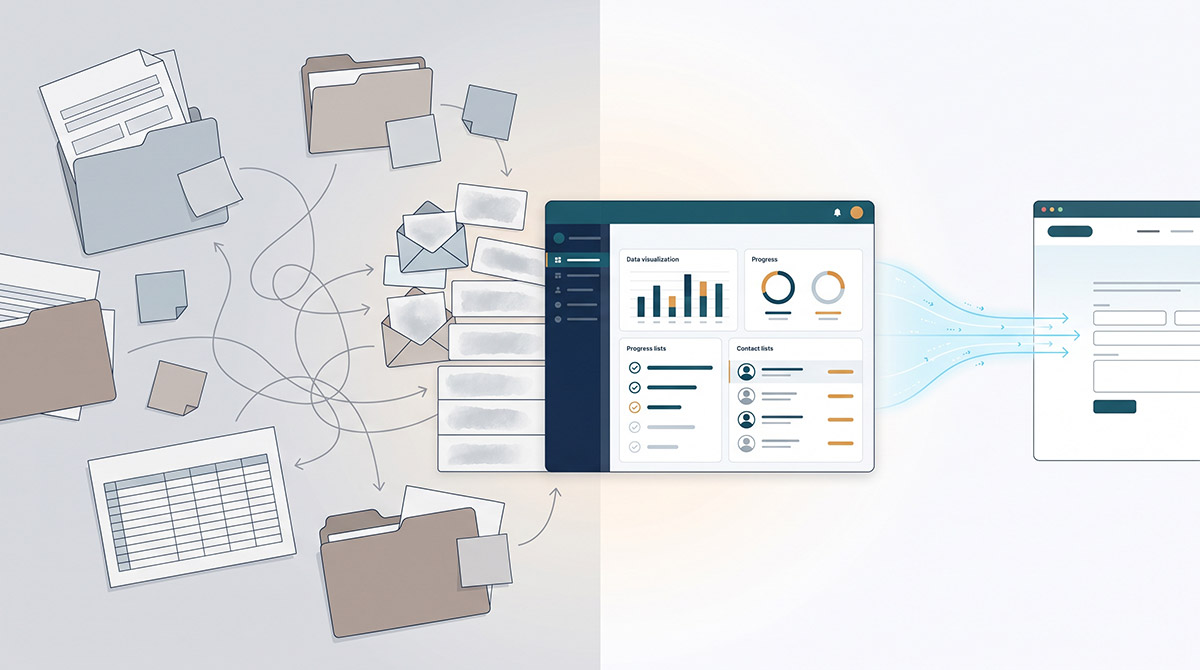


When a team is exporting CSVs on Friday, rekeying customer data on Monday and still arguing over which dashboard is correct by Wednesday, the problem is not effort. It is architecture. Knowing how to connect business systems is less about plugging tools together and more about deciding how data, processes and ownership should work across the organisation.
For enterprise teams, government bodies and growing businesses, disconnected platforms create more than inconvenience. They slow service delivery, weaken reporting, increase compliance risk and make every new digital investment harder to justify. A website, CRM, ERP, ecommerce platform, mobile app and marketing automation stack should not behave like separate projects. They need to operate as one ecosystem, with clear rules and a commercial purpose behind every connection.
Why connecting systems goes wrong
Most integration problems start well before any technical build. A business adds a new platform to solve an immediate need, then another team procures a different tool, and before long the organisation is relying on manual workarounds to bridge the gaps. Data ends up duplicated, inconsistent or delayed. Teams lose confidence in what they are seeing, so they create their own parallel processes.
The other common issue is treating integration as an afterthought. A new website goes live without proper CRM logic. An ecommerce build pushes orders into finance, but not stock updates back to the front end. A customer portal looks polished, yet staff still need to move information by hand between internal systems. The interface may be new, but the operating model stays messy.
That is why the question is not simply how to connect business systems. It is which systems should connect, what information needs to move, when it should move and who is responsible when something fails.
Start with business logic, not tools
The strongest integration projects begin with operational clarity. Before selecting middleware, APIs or custom development, define the business outcomes first. Do you need to reduce manual processing time, improve customer visibility, shorten lead response times, centralise reporting or support future growth across channels? Different goals lead to different technical choices.
From there, map the core processes that matter. Lead capture, customer onboarding, product management, order handling, service requests, invoicing and reporting are usually better starting points than a platform-by-platform review. This shifts the conversation from features to flow. It shows where data originates, where it needs to go and where bottlenecks currently sit.
This stage often reveals an uncomfortable truth. Not every process deserves to be automated immediately. If a workflow is inconsistent or poorly governed, connecting it faster can simply spread bad data across more systems. In those cases, process refinement should come before integration.
How to connect business systems without creating more complexity
There is no single integration model that suits every organisation. The right approach depends on your platform mix, internal capability, compliance requirements and tolerance for risk.
Point-to-point integrations can work well when the environment is relatively simple and only a few systems need to exchange data. They are often faster to launch and can be cost-effective in the short term. The trade-off is maintenance. As more systems are added, those one-off connections become harder to govern and more expensive to change.
A central integration layer, whether through an iPaaS platform, middleware or a custom orchestration approach, offers more control in complex environments. It can standardise data handling, improve monitoring and reduce the dependency on brittle custom links between individual systems. The trade-off here is upfront planning and investment. It is usually the better fit for organisations with multiple platforms, compliance obligations or long-term transformation goals.
Batch integrations also have a place. Not every system needs real-time exchange. Financial reconciliation, reporting snapshots and lower-priority administrative updates may be perfectly acceptable on a scheduled basis. Real-time integrations are valuable when timing affects customer experience, operations or decision-making, but they add complexity and should be used where they matter.
The key is restraint. Good integration design is not about connecting everything because you can. It is about connecting the right things, in the right way, with a clear purpose.
Define your source of truth
One of the fastest ways to create friction is letting multiple platforms compete as the authoritative record for the same information. If the CRM, ERP and website all treat customer data differently, teams will spend more time correcting records than using them.
Every critical data set should have a defined source of truth. That includes customers, products, pricing, orders, inventory, service history and consent data where relevant. Once that ownership is clear, the integration rules become easier to design. One system creates or controls the record, others consume or enrich it according to agreed logic.
This matters just as much for governance as it does for efficiency. If no one can answer where a field originates, who can change it and how updates are validated, the integration is already carrying operational risk.
Prioritise the journeys that affect performance
A sensible integration roadmap does not begin with every possible connection. It starts with the journeys that have the strongest operational or commercial impact.
For some organisations, that means connecting website forms, CRM workflows and marketing automation so leads are routed properly and followed up faster. For others, it means linking ecommerce, inventory, fulfilment and finance to reduce order errors and improve reporting. In more service-led environments, the focus might be customer portals, case management and internal systems that support delivery teams.
This is where senior planning matters. A technically successful integration can still be a poor investment if it addresses a low-value process while bigger bottlenecks remain untouched. Prioritisation should reflect effort, dependency, business value and risk reduction, not just technical convenience.
Build for visibility, not just connectivity
A connection that works silently until it fails is not enough. Teams need visibility into what is happening across the ecosystem. That means logging, monitoring, alerting and clear escalation paths. If an API drops out, a data sync stalls or a validation rule rejects records, the right people should know quickly and know what to do next.
This is where many projects fall short. They invest in the connection itself but not in operational support. The result is fragile infrastructure that technically exists, yet becomes unreliable under pressure.
Well-connected systems should also improve reporting quality. When platforms are aligned properly, leadership can trust the numbers, teams can work from the same information and optimisation becomes far more practical. Better reporting is not a side benefit. It is often one of the clearest signs that integration has been done well.
Security, governance and change control matter
The more connected your systems become, the more disciplined your governance needs to be. Permissions, data access, audit trails, retention policies and vendor dependencies all need attention early, not after launch.
This is especially relevant for government and enterprise environments where compliance expectations are high and internal stakeholders are numerous. A new integration may affect legal, procurement, IT, operations, customer service and marketing at the same time. Without clear ownership and change control, even a sensible enhancement can introduce avoidable risk.
Documentation matters here. So does version control. So does testing. If an upstream platform changes a field, endpoint or business rule, the downstream impact should not come as a surprise. Mature integration programmes assume change will happen and plan for it.
Choose partners who understand the whole ecosystem
Connecting systems is not just a development task. It sits at the intersection of strategy, UX, data architecture, platform capability and operational delivery. That is why organisations often struggle when separate vendors each own a slice of the puzzle but no one owns the full outcome.
A website agency may build the front end without considering CRM logic. A software vendor may configure the platform without thinking about customer journeys. An internal team may manage automation but lack the broader architecture view. The gaps between those decisions are where performance is lost.
ID Digital Agency works with organisations facing exactly this kind of complexity by aligning strategy, platform decisions and integration delivery from the outset. That matters because connected systems do not happen by chance. They come from deliberate planning, disciplined execution and ongoing optimisation.
What good looks like
A well-connected digital ecosystem is usually less dramatic than people expect. Staff spend less time correcting records. Customers get faster, more consistent experiences. Reporting becomes believable. New initiatives are easier to launch because the foundation is already coherent.
There is still complexity behind the scenes, of course. But it is managed complexity, not accidental patchwork. That distinction shapes cost, speed, governance and long-term performance.
If you are working out how to connect business systems, start by asking a harder question than which tools should talk to each other. Ask how your organisation should operate when the systems finally do.