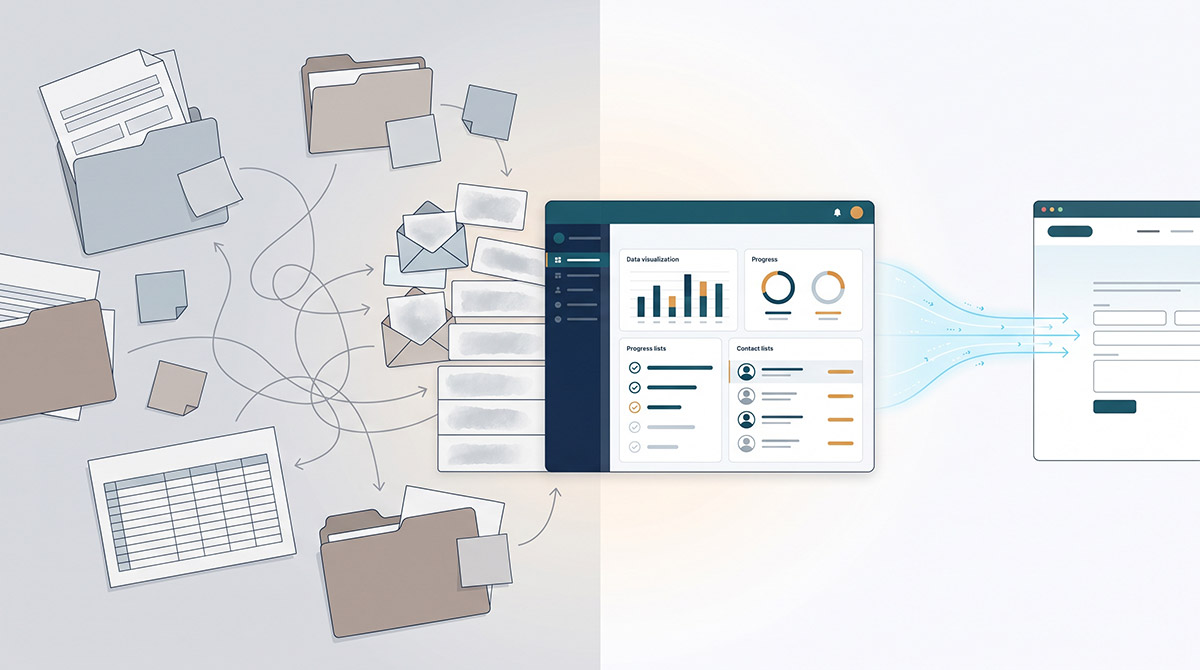


If your website, CRM, ecommerce platform, marketing tools and internal systems all hold different versions of the truth, you do not have a digital strategy problem first. You have a systems problem. That is usually where the question of what is a digital ecosystem starts to matter.
A digital ecosystem is the connected set of platforms, data, processes and user experiences that allow an organisation to operate as one joined-up digital environment. It is not a single tool, and it is not just a website. It includes the systems customers see, the systems teams use behind the scenes, and the way information moves between them.
For organisations with any real scale, this is not a theoretical concept. It affects lead quality, service delivery, reporting accuracy, governance, operational efficiency and growth. When the ecosystem is fragmented, teams compensate with manual workarounds, duplicate data entry and disconnected reporting. When it is well designed, the business gets more control, better visibility and fewer points of failure.
What a digital ecosystem actually includes
A digital ecosystem can be broad or narrow depending on the organisation, but the principle is the same. It is the combined environment of digital touchpoints, operational platforms and integration layers that support the customer journey and internal workflows.
In practical terms, that often includes a website or app, a CMS, CRM, marketing automation platform, ecommerce system, booking or service platform, analytics stack, customer support tools, ERP or finance systems, and the integrations that connect them. It may also include identity and access management, governance controls, search capability, personalisation tools and reporting dashboards.
The important part is not the number of systems. It is whether those systems are designed to work together. Plenty of organisations have invested heavily in digital platforms and still operate with a messy ecosystem because each tool was selected or implemented in isolation.
Why the ecosystem matters more than any single platform
A standalone website can look polished and still underperform commercially. A CRM can be expensive and still fail to improve customer relationships. A marketing automation platform can send highly targeted campaigns while creating poor data hygiene in the background. Individual tools do not create performance on their own.
The ecosystem matters because business outcomes happen across systems, not inside one of them. A customer might discover your brand through search, land on your website, submit an enquiry, enter a CRM workflow, speak with your team, receive automated updates and complete a transaction through another platform. If those touchpoints are disconnected, the experience degrades and the organisation loses efficiency.
This is also where governance becomes critical. A digital ecosystem is not just about convenience or speed. It is about creating a structure that supports clean data, clear ownership, secure access, manageable change and reliable reporting. Without that, scale tends to increase complexity faster than it increases value.
What is a digital ecosystem in business terms?
For leadership teams, the better question is often not what is a digital ecosystem, but what role does it play in business performance.
At a business level, a digital ecosystem is the operating model behind your digital channels. It determines how well your front-end experiences connect with back-end processes. It affects whether teams can trust the data they are using. It shapes how quickly the business can launch improvements, respond to customer behaviour and adapt to changing requirements.
A strong ecosystem usually delivers value in four areas.
First, it improves efficiency. Teams spend less time moving information between systems, fixing errors or chasing missing context.
Second, it improves customer experience. Users encounter fewer dead ends, inconsistent messages or duplicated steps.
Third, it improves decision-making. Reporting becomes more reliable when platforms are integrated and data definitions are aligned.
Fourth, it reduces risk. Clear architecture, governance and ownership make the digital estate easier to manage over time.
None of this means every organisation needs a highly complex stack. The right ecosystem is the one that fits current needs while allowing for growth. Over-engineering creates its own costs.
The difference between a digital ecosystem and a tech stack
These terms are often used as if they mean the same thing, but they do not.
A tech stack is the collection of technologies an organisation uses. A digital ecosystem is how those technologies, data flows, users and processes interact to support business outcomes.
That distinction matters. You can have a modern stack and still have a weak ecosystem if there is no clear integration strategy, no governance model and no alignment between platforms and operational needs. On the other hand, a simpler stack can perform very well if it is structured properly, integrated intelligently and managed with discipline.
This is why platform procurement on its own rarely solves the underlying problem. Replacing one tool with another does not automatically fix fragmented workflows or poor data architecture. The work sits in strategy, design, implementation and ongoing optimisation.
Signs your digital ecosystem is not working
Most organisations do not need a formal audit to sense when something is off. The signs tend to show up in day-to-day operations.
Sales and marketing report different numbers. Website leads arrive in the CRM incomplete or duplicated. Staff export spreadsheets to bridge system gaps. Customers repeat the same information across channels. Internal teams rely on key individuals to explain how processes actually work. Small changes take too long because nobody is confident about what they might break.
These are not minor irritations. They are indicators that the ecosystem lacks structure.
There is also a more subtle problem. Fragmented ecosystems make strategy harder to execute. When data is inconsistent and systems are loosely connected, leaders struggle to prioritise investment. They cannot easily see which touchpoints are underperforming, where bottlenecks sit or what improvements will deliver the highest return.
What a well-designed digital ecosystem looks like
A strong digital ecosystem is usually less visible than people expect. It does not announce itself with complexity. It feels controlled.
Data moves predictably between systems. User journeys make sense across channels. Teams know which platform owns which information. Reporting is credible. Changes can be made without creating chaos elsewhere. The architecture supports performance rather than getting in its way.
There is also a clear balance between central control and practical usability. Overly rigid ecosystems can slow teams down. Overly loose ecosystems create inconsistency and risk. The right model depends on the organisation, its compliance obligations, internal capability and growth plans.
For some businesses, that means a tightly governed enterprise setup. For others, it means a simpler ecosystem with strong foundations and room to expand. What matters is intentional design.
Building a digital ecosystem properly
The process should start with business needs, not software demos. Before selecting platforms or planning integrations, it is worth mapping how the organisation actually operates - customer journeys, team workflows, data dependencies, reporting needs, approval structures and known pain points.
From there, the architecture can be defined. That includes deciding which platforms should do what, where data should live, how systems should connect and what governance is required. This is also the point where trade-offs need to be addressed honestly. Best-of-breed tools can offer depth, but they often increase integration complexity. Consolidated platforms can simplify management, but they may limit flexibility in some areas.
Implementation then needs to follow that architecture with discipline. Integration logic, user roles, content structures, automation rules and reporting frameworks all need to align. If these decisions are made ad hoc during delivery, the ecosystem starts drifting before it is even launched.
After launch, the job is not finished. Ecosystems need active management. Platforms change, business priorities shift and customer expectations move. Ongoing optimisation, governance and performance monitoring are what keep the system useful rather than merely functional.
This is where a connected delivery model matters. Strategy, UX, development, integration and performance should inform each other. That is the difference between assembling tools and building an ecosystem.
Why this matters for Australian organisations now
Many Australian organisations are carrying the weight of layered digital decisions made over years - a website rebuilt here, a CRM added there, a marketing platform switched under pressure, an internal tool adopted by one team but not another. Each decision may have been reasonable in isolation. Together, they often create friction.
That friction becomes more expensive as expectations rise. Customers expect consistency. Teams expect visibility. Leadership expects measurable returns from digital investment. None of that is easy to achieve with disconnected platforms and manual processes sitting underneath.
For organisations managing complexity, the question is no longer whether digital channels matter. It is whether the underlying ecosystem is helping or hindering performance. Agencies such as ID Digital Agency are increasingly brought in for exactly that reason - not just to deliver a site or platform, but to create a more coherent operating environment across the whole digital estate.
A useful way to think about it is this: a digital ecosystem is the structure that determines whether your digital investment compounds or fragments. If the parts work together, performance improves over time. If they do not, every new tool adds cost, risk and operational drag.
The smartest next step is rarely to buy more technology. It is to get clear on how your existing and future platforms should work together, who owns what, and where integration will create the most value.