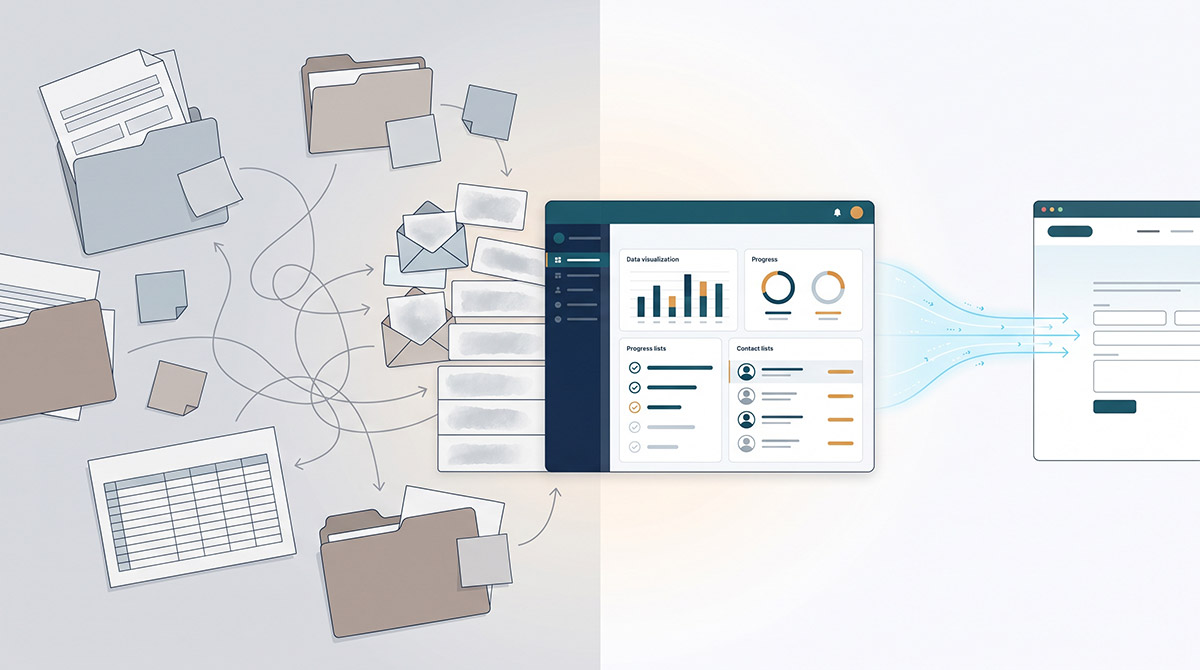


A website rebuild looks productive on paper. So does a new CRM, a marketing automation rollout, or an ecommerce upgrade. The problem starts when each investment is planned in isolation. A proper digital ecosystem planning guide helps you avoid that pattern by treating your website, apps, platforms, integrations and operational workflows as one connected system.
For organisations with real digital complexity, this is not a branding exercise. It is an operating model decision. If your platforms do not share data properly, your reporting is unreliable, your teams create workarounds, and every improvement costs more than it should. That is usually where wasted spend hides - not in one bad tool, but in the gaps between them.
What a digital ecosystem planning guide should actually cover
Most planning documents fail because they are too narrow. They focus on channels, campaigns or a single platform. A useful digital ecosystem planning guide starts with the business model, the service model and the operational realities behind both.
That means looking at how customers find you, how they move through your digital touchpoints, how internal teams manage information, and where critical systems need to exchange data. In practice, this might include your website, ecommerce platform, CRM, ERP, marketing automation, customer portal, mobile app, analytics stack, search visibility, support systems and internal workflows.
The point is not to map everything for the sake of completeness. The point is to identify what matters commercially and operationally. Some organisations need a tightly integrated lead generation and CRM flow. Others need complex product, pricing or inventory logic across multiple platforms. Government and enterprise teams often need stronger governance, security and publishing control than a fast-growth retailer. The right plan depends on the risk profile, the delivery model and the scale of change.
Start with business outcomes, not platforms
If the first workshop is about software preferences, the plan is already drifting. Good ecosystem planning starts with clear outcomes. Reduce duplicated administration. Improve lead quality. Shorten sales response times. Give customers better self-service. Consolidate reporting. Lower platform risk. Support growth without adding manual process.
These outcomes create the filter for every later decision. Without them, teams end up debating features instead of priorities. A platform might be technically impressive and still be the wrong choice if it adds governance issues, ongoing overhead or integration constraints.
This is also where executive alignment matters. Marketing may want speed and content flexibility. Operations may want workflow control and cleaner data. IT may want stability, compliance and maintainability. Leadership may want lower risk and clearer ROI. A planning process that ignores those tensions does not remove them. It simply pushes them into delivery, where they become more expensive.
Audit the current ecosystem with honesty
Before defining the future state, you need a realistic view of the current one. That means more than a list of tools. You need to understand how they are used, who owns them, what data they hold, where they overlap and where they fail.
In most organisations, the visible stack is only part of the picture. The real ecosystem often includes spreadsheets managing approvals, inboxes filling process gaps, manual exports feeding reports, and legacy systems that no one wants to touch but everyone depends on. Those workarounds are not minor details. They are often the clearest sign that the ecosystem was never properly planned.
A useful audit looks at six practical areas: platforms, integrations, data quality, governance, user experience and performance. If one system holds customer records but another is treated as the source of truth, that needs to be resolved. If content publishing depends on one person knowing undocumented steps, that is a governance risk. If multiple teams collect the same data in different formats, that will affect reporting, automation and customer experience.
Define the future state with control in mind
Future-state planning is where many projects become unrealistic. Teams describe an ideal world with every platform connected, every process automated and every stakeholder satisfied. A better approach is to define what must be true in the future environment for the business to operate more effectively.
That includes platform roles, ownership, integration logic and decision rights. Which system is the source of truth for customer data? Where should transactions occur? What belongs in the CMS versus the CRM? Which workflows should be automated, and which still require human review? How will user permissions, content governance and security be managed?
These are not technical footnotes. They shape the long-term cost and reliability of the ecosystem. More integration is not always better. In some cases, direct integrations improve speed and accuracy. In others, they create brittle dependencies that are hard to maintain. The right answer depends on scale, internal capability and how often the business changes.
A digital ecosystem planning guide needs a delivery roadmap
A strategy without sequencing is just a wish list. One of the most practical parts of any digital ecosystem planning guide is the roadmap that turns ambition into a manageable program of work.
This roadmap should separate foundational work from visible outputs. Brand and UX foundations may need to come before a website redesign. Data cleanup may need to happen before CRM automation. Integration architecture may need to be resolved before launching new self-service tools. If these dependencies are ignored, teams often deliver polished interfaces on top of unstable systems.
Phasing matters for another reason: risk. A wholesale replacement of every platform may sound efficient, but it can create unnecessary disruption. In many cases, staged modernisation is the smarter path. You might stabilise analytics and reporting first, then rebuild the website, then connect CRM workflows, then introduce automation or commerce enhancements. That approach gives the organisation time to adapt while keeping control of cost and complexity.
Governance is not a side issue
Digital ecosystems rarely fail because the design looked poor in workshops. They fail because ownership is unclear after launch. No one knows who approves changes, who maintains integrations, who monitors performance, or who is accountable for data quality.
That is why governance should be built into the planning phase, not added later. A strong governance model defines system ownership, content responsibilities, change management processes, platform standards and measurement frameworks. It should also address procurement realities, compliance obligations and vendor dependencies.
For enterprise and government teams, this is usually non-negotiable. For mid-market organisations, it is often the missing layer that explains why previous projects lost momentum. Governance is not bureaucracy for its own sake. It is how you protect continuity, reduce risk and keep the ecosystem useful after the initial project team moves on.
Measure performance across the whole system
Too many digital programs are measured by launch milestones. The website goes live. The app is released. The platform is implemented. None of that tells you whether the ecosystem is doing its job.
Measurement should reflect the connected nature of the environment. That means tracking commercial and operational indicators together. Lead conversion matters, but so does lead routing accuracy. Ecommerce revenue matters, but so does catalogue integrity and fulfilment efficiency. Content engagement matters, but so does publishing speed and governance compliance.
This is where integrated planning has a compounding effect. When systems are structured properly, reporting becomes more credible. Teams spend less time reconciling inconsistent numbers and more time improving performance. That is a major advantage for organisations under pressure to justify digital investment.
What good planning changes in practice
When digital ecosystem planning is done well, the results are usually less dramatic than a launch campaign and far more valuable. Teams gain clarity on what each platform is for. Data moves with fewer manual interventions. Customers encounter fewer breaks in the journey. Reporting improves. Change becomes easier to manage because the architecture has logic behind it.
Just as importantly, decision-making improves. Instead of asking whether a new tool looks useful, leaders can ask whether it fits the ecosystem, supports governance and advances a defined business outcome. That is a stronger position than reacting to platform trends or internal pressure.
For organisations managing multiple stakeholders, service lines or legacy systems, this discipline matters. It is the difference between digital investment that compounds and digital investment that fragments. This is the thinking ID Digital Agency applies when helping organisations move beyond disconnected tools and patchwork delivery.
If your current environment depends on manual workarounds, duplicate data or isolated platform decisions, the next project is probably not the fix on its own. The better move is to plan the ecosystem first, then build with purpose.