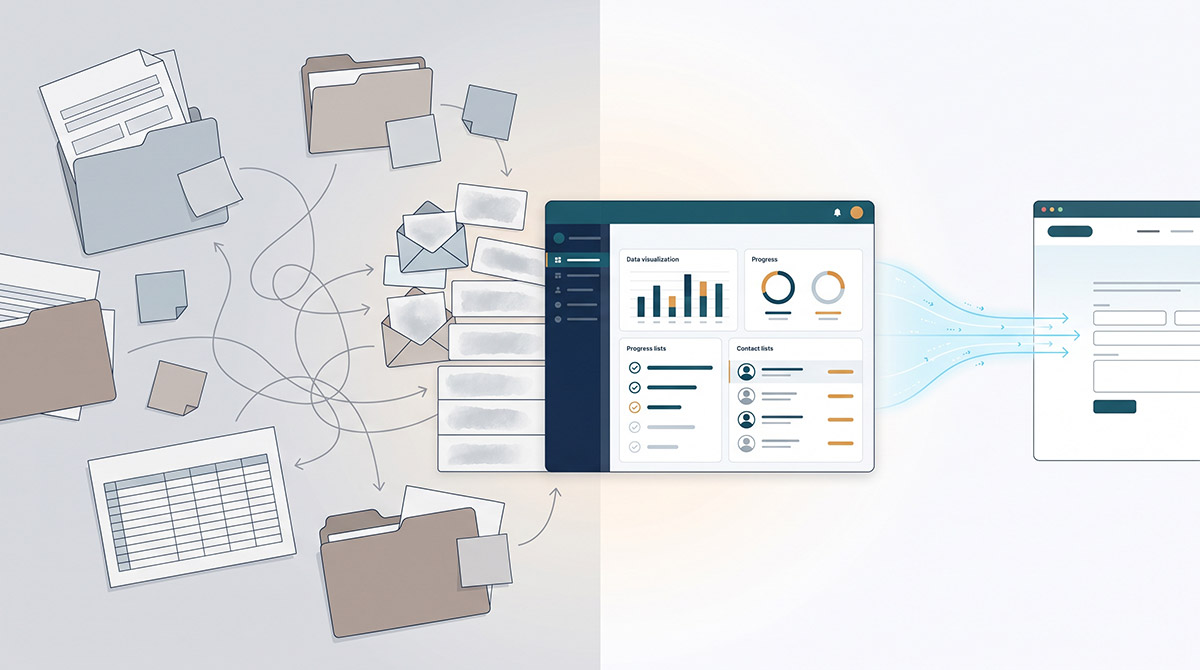


A customer submits an enquiry through your website. A team member copies the details into a CRM, sends an acknowledgement email, creates a task, checks stock or service availability, and updates a spreadsheet for reporting. None of these actions is difficult. Together, they create delay, duplicate data and avoidable risk. Business process automation replaces that chain of manual hand-offs with a controlled workflow that moves information to the right system and person at the right time.
For organisations managing multiple platforms, automation is not simply about saving a few admin hours. It is a way to improve data quality, strengthen governance and make the customer experience more consistent. Done well, it reduces operational friction without removing the judgement that experienced people need to apply.
What business process automation should solve
The strongest automation programmes begin with a business problem, not a software licence. If a workflow is unclear, inefficient or poorly governed, automating it will only help the organisation make mistakes faster.
Start by looking for work that is repetitive, rules-based and dependent on information moving between systems. Common examples include enquiry routing, lead qualification, customer onboarding, ecommerce order updates, approval processes, support triage, renewal reminders and reporting. These workflows often sit across a website, CRM, ecommerce platform, finance system, marketing platform and internal tools.
The objective is not to automate every interaction. A high-value process is one where automation can reliably remove administrative effort while improving speed, accuracy or visibility. A customer may appreciate an immediate order confirmation, for example. A complex service enquiry may still need a senior person to assess context before a proposal is prepared.
That distinction matters. Automation should handle the predictable work so your team can focus on the work that needs expertise, accountability and commercial judgement.
The real value is connected data
Most operational problems are not caused by a lack of tools. They are caused by tools that do not share a dependable source of truth. A sales team works in one platform, customer service in another, marketing in a third, and the website captures data that has to be manually re-entered somewhere else.
This creates familiar issues: duplicate customer records, missed follow-ups, inconsistent reporting and disputes over which data is current. It also makes compliance and governance harder because no one can see the full path a record has taken.
Business process automation is most effective when it is designed as part of a connected digital ecosystem. A website form should create or update the correct CRM record. Consent preferences should carry through to marketing activity. A completed transaction should trigger the appropriate fulfilment, service and reporting workflows. If an exception occurs, it should be visible to the team responsible for resolving it.
Integration is what turns these individual actions into a system. Without it, organisations often end up with a collection of automations that work in isolation but create new dependencies and blind spots.
Map the process before selecting the technology
A process map is not bureaucracy. It is how you find the points where time, data and responsibility are being lost.
Document the current workflow from trigger to outcome. Identify who performs each action, what information they need, where that information comes from, which decisions require approval and what happens when something goes wrong. Include the less obvious steps, such as sending internal notifications, correcting data or chasing missing information.
Then define the future-state process. This should clarify which actions will be automated, which will remain manual, how exceptions are handled and who owns the workflow over time. It is also the right point to challenge outdated requirements. A process that exists because of a legacy system limitation may no longer be necessary.
For larger organisations, process mapping should involve operations, marketing, sales, customer service, IT and governance stakeholders. Each group sees a different failure point. Bringing them together early prevents a technically correct solution that does not work in practice.
Build workflows around clear triggers and ownership
Every reliable automation has a clear trigger, a defined action and an accountable owner. The trigger could be a form submission, a status change, a payment event, a document upload or a scheduled date. The action might create a record, assign a task, send a notification or update a customer journey.
The complexity sits between these two points. What happens if the CRM record already exists? What if a required field is missing? What if the value exceeds an approval threshold? What if the integration service is unavailable? These are not edge cases to leave until launch. They are part of the process design.
A practical workflow should include validation rules, error alerts and a route for human intervention. It should also avoid sending sensitive information through channels that are not appropriate for the data involved. For government bodies and regulated organisations, privacy, access controls, audit trails and record retention need to be designed in from the start.
Ownership is equally important. Someone needs authority to review performance, update rules and approve changes. Automation without ownership gradually becomes difficult to trust, particularly when staff change or platforms are replaced.
Start with one measurable workflow
A broad transformation roadmap may involve dozens of processes, but the first release should be focused. Choose a workflow with a visible pain point, enough transaction volume to matter and a result that can be measured.
For example, an organisation might automate the route from website enquiry to CRM assignment and follow-up. Before implementation, establish the baseline: average response time, number of manual touches, incomplete records, conversion rate and staff time spent on administration. After launch, measure the same indicators.
This approach creates proof before scale. It also exposes the operational realities that are easy to miss during planning, such as inconsistent form inputs, unclear ownership rules or staff who need different notifications than expected.
The best first workflow is not always the largest. A smaller, well-defined process can establish integration patterns, governance standards and confidence across the organisation. Those foundations make later work faster and less risky.
Where automation can go wrong
Automation has trade-offs. A workflow that is too rigid can frustrate staff and customers when circumstances do not fit the expected path. A workflow that contains too many conditions can become difficult to test, maintain and explain.
Over-automation is also a risk in customer-facing communications. A sequence of perfectly timed emails is not helpful if it ignores a recent conversation with a sales representative or sends a renewal message after a customer has cancelled. Systems need shared data, suppression rules and sensible boundaries.
Another common issue is relying on point-to-point connections without a broader architecture. These can be useful for a simple requirement, but a growing organisation can quickly accumulate fragile dependencies. When one platform changes, several workflows may fail without anyone knowing immediately.
A better approach is to define integration standards, document data ownership and monitor critical flows. This does not mean every process needs enterprise-level complexity. It means the solution should match the operational risk and expected scale.
Measure performance beyond hours saved
Time savings are valuable, but they are only one part of the business case. A well-designed automation programme should also improve service quality, revenue performance, compliance and management visibility.
Useful measures may include lead response time, conversion rates, order processing errors, customer onboarding completion, case resolution time, data completeness, rework rates and the number of exceptions requiring intervention. The right measures depend on the workflow and the commercial objective behind it.
Review these results regularly. A process may perform well at launch but become less effective as products, customer expectations or team structures change. Continuous optimisation is where automation shifts from a one-off technical project to an operational capability.
Business process automation needs a long-term operating model
Technology can execute the workflow, but it cannot decide whether the workflow still serves the business. Organisations need a practical operating model for change: documented processes, clear owners, controlled access, testing procedures and a way to prioritise future improvements.
This is particularly relevant when websites, CRM platforms, apps and ecommerce systems all contribute to the customer journey. Changes in one area can affect data, communications and reporting elsewhere. Treating automation as part of the wider digital ecosystem gives teams more control over those dependencies.
ID Digital Agency approaches automation through that connected lens: strategy, platforms, data and customer experience need to work together rather than add more patchwork to an already complex environment.
The useful question is not, “What can we automate?” It is, “Where is manual effort preventing the organisation from responding well?” Start there, establish a process that people can trust, and build outward with purpose.