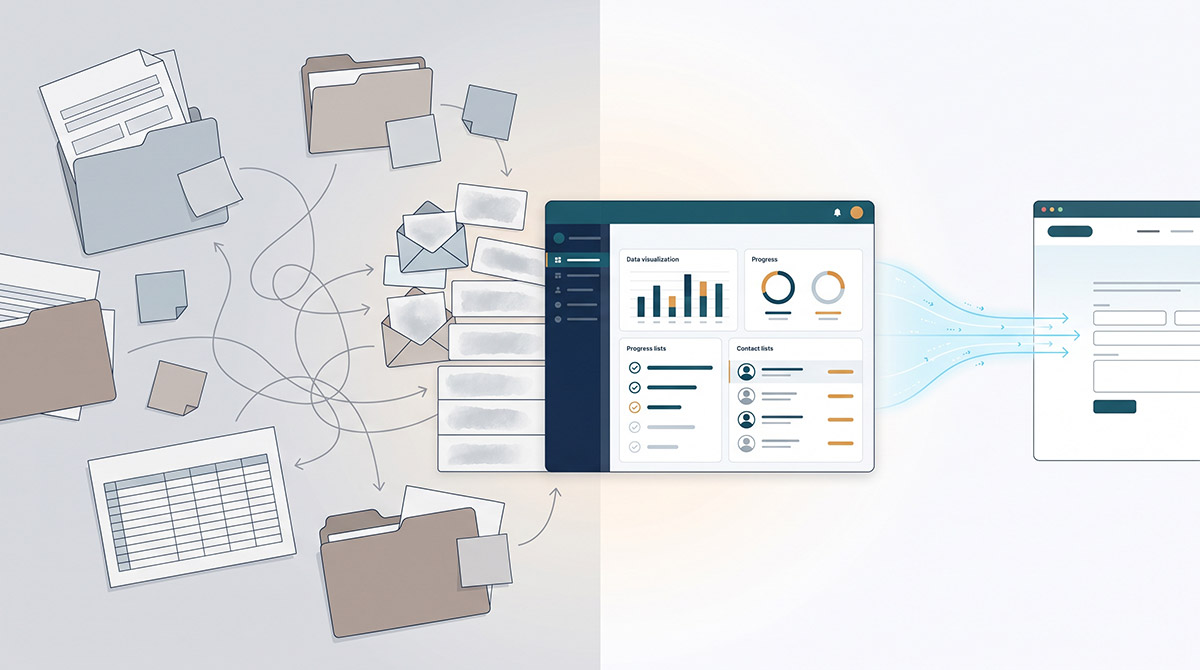


An app brief rarely starts with the real problem. On paper, it might be a customer portal, a booking tool or an internal operations app. In practice, the harder question is whether the mobile app development company you choose can connect that app to the rest of your business without creating more complexity, more duplicate data and more risk.
That distinction matters. Plenty of teams can produce screens and ship code. Far fewer can help an organisation define what the app needs to do commercially, how it should fit into existing systems, and what governance is required once it goes live. If your organisation already manages a website, CRM, ERP, ecommerce stack, marketing tools or internal workflows, the app is not a standalone asset. It is one part of a broader digital ecosystem.
What a mobile app development company should actually deliver
A good mobile app development company does more than build features from a list. It helps clarify the role of the app, challenge assumptions early and reduce avoidable delivery risk.
That starts with strategy. Before design or development begins, there should be a clear view of the business case, the users, the success measures and the operational model behind the product. Is the app intended to increase revenue, reduce service costs, improve field efficiency, support compliance or strengthen customer retention? Different objectives lead to different technical and UX decisions.
It also requires technical depth beyond the app itself. Mobile products often depend on APIs, user authentication, third-party services, data models, content workflows, analytics and support processes. If those foundations are weak, the app inherits the problem. What looks polished in a demo can become expensive to maintain once real users, real integrations and real security requirements come into play.
Why app projects go off track
Most failed app projects do not fail because mobile technology is especially difficult. They fail because the surrounding decisions are weak.
One common issue is treating the app as a separate initiative. The business commissions an app team, the website sits with another supplier, the CRM is managed internally, and no one owns the integration model end to end. The result is patchwork. Users see inconsistent information, staff resort to manual workarounds, and reporting becomes unreliable.
Another issue is over-scoping too early. It is tempting to specify every possible feature in the first release, especially when multiple stakeholders are involved. But a larger feature set does not automatically produce a better outcome. In many cases, it slows validation, inflates cost and creates more points of failure. A disciplined partner will usually push for sharper prioritisation.
Then there is governance. Mobile apps are not launch-and-leave products. Operating systems change. Devices change. User expectations change. Security obligations do not stand still. A mobile app development company should be able to explain not only how the app will be built, but how it will be maintained, measured and improved over time.
How to assess a mobile app development company
The first test is whether the conversation starts with your business model or with their preferred tech stack. Tools matter, but they are secondary. If the agency is leading with frameworks before understanding users, workflows, data sources and internal constraints, the process is probably the wrong way around.
The second test is integration thinking. Ask how the app will connect to your existing platforms, who owns the data, what happens when external systems change, and how failure points will be managed. If the answer is vague, the risk is not just technical. It becomes operational.
The third test is delivery maturity. You want clarity on discovery, architecture, UX design, development, QA, release management and post-launch support. There should be a defined process, but not a rigid one. Enterprise and government environments often require tighter controls, while growth-stage businesses may need more flexibility. A capable partner knows when to be structured and when to move faster.
Commercial discipline matters too. The cheapest quote is often built on assumptions that surface later as change requests, delays or reduced quality. The most expensive proposal is not automatically the safest either. What matters is whether scope, dependencies, responsibilities and ongoing costs are transparent from the outset.
Native, cross-platform and the trade-off conversation
A credible mobile app development company should be comfortable discussing trade-offs rather than pushing one approach every time.
Native development can make sense when performance, device-specific features or platform-specific UX are central to the product. It can also support stronger optimisation in some use cases. The trade-off is usually cost and maintenance overhead, particularly if you are supporting both iOS and Android with separate codebases.
Cross-platform development can be a strong option when speed, efficiency and consistent functionality across platforms matter more than highly specialised native behaviour. For many organisations, that balance is commercially sensible. But it still depends on the app's complexity, expected lifespan and integration requirements.
There is no universal right answer. A serious partner will explain where each option fits, what risks come with it and how the choice affects future change.
The role of UX in app performance
Too many app projects still treat user experience as decoration applied after requirements are locked in. That approach usually creates friction. If users cannot complete tasks quickly, trust the data they see, or understand what happens next, adoption suffers.
Good app UX is operational, not cosmetic. It should reflect how people actually behave in context, whether they are customers making repeat purchases, staff completing field tasks or stakeholders approving requests on the move. The interface needs to support speed, clarity and confidence.
That means a mobile app development company should be testing assumptions early through journeys, wireframes and prototypes, not waiting until development is advanced. It also means designing with edge cases in mind. Poor connectivity, interrupted sessions, role-based access and inconsistent source data all affect mobile experiences in the real world.
Why integration matters more than features
Feature lists are easy to sell because they are visible. Integration work is less visible, but it often determines whether the app creates value.
If customer data is duplicated across systems, if staff need to update records manually, or if the app presents stale information because the backend sync is unreliable, the product becomes another layer of inefficiency. The business then carries extra support costs, governance issues and user frustration.
This is where a broader digital view matters. A mobile app should strengthen the ecosystem around it, not compete with it. When strategy, UX, platform architecture and connected systems are planned together, the result is usually simpler operations, stronger reporting and more control over change.
That is why organisations with real digital complexity often benefit from working with a partner that can look beyond the app build alone. At ID Digital Agency, that means approaching mobile work as part of a connected platform environment rather than an isolated deliverable.
Questions worth asking before you appoint a partner
The useful questions are rarely about whether a team can code. Most can. The better questions get closer to risk, fit and long-term value.
Ask how discovery is run and how decisions are validated before development starts. Ask who is responsible for architecture and how integrations are documented. Ask what happens after launch, how support is handled and how performance is measured. Ask what assumptions sit behind the quote and what could change the budget.
You should also ask for evidence of commercial thinking. Has the team worked with organisations that need governance, stakeholder alignment and operational continuity, not just fast visual output? Do they understand procurement realities, internal approvals and the need for scalable solutions that will still make sense in two years?
Those answers tend to reveal more than a polished prototype ever will.
Choosing for longevity, not just launch
The right mobile app development company is not the one that promises the most in the shortest timeframe. It is the one that can make sensible decisions with you, challenge the wrong assumptions, and build an app that works properly inside the larger system your organisation depends on.
That may mean a tighter first release. It may mean more time spent on discovery, architecture or integration planning before a single screen is developed. It may also mean saying no to features that add noise without adding value. Those are usually signs of maturity, not hesitation.
If the app matters to customer experience, service delivery or internal efficiency, treat the selection process accordingly. The build is only one part of the investment. The bigger decision is choosing a partner that can help you reduce complexity, improve control and create something your organisation can maintain with confidence.