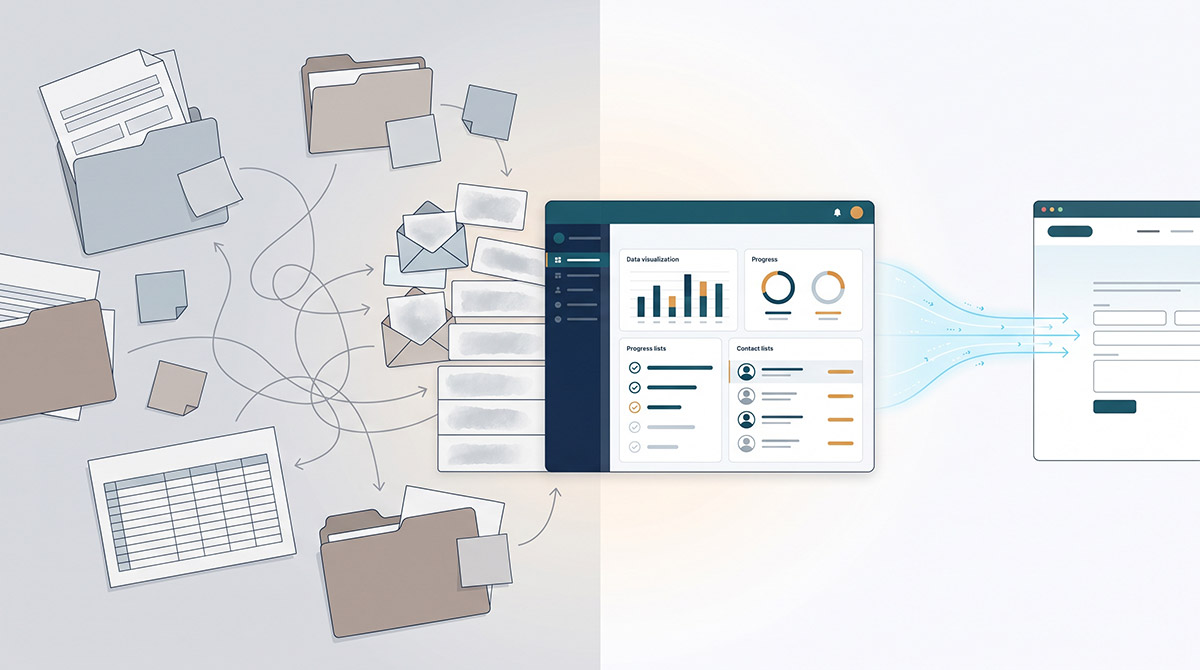


Most integration problems do not start with technology. They start when a business adds one more platform to solve one immediate issue, then another, then another, until the website, CRM, ecommerce stack, finance system and reporting tools all run on separate logic. Teams compensate with spreadsheets, rekeying and workarounds. Data drifts. Reporting loses credibility. Growth gets harder than it should be.
That is where platform integration services matter. Done properly, they connect the systems that already run your organisation so information moves accurately, processes happen at the right time and teams work from the same source of truth. The point is not to add complexity. It is to remove friction, reduce risk and give the business more control over how digital operations actually function.
What platform integration services actually involve
Platform integration services are often misunderstood as a technical add-on at the end of a project. In practice, they sit much closer to business operations. They define how platforms exchange data, what triggers actions, where information should live and how users move across systems without breaking the experience or creating duplicate effort.
That might mean connecting a website to a CRM so enquiries route correctly and sales teams can respond with context. It might involve integrating an ecommerce platform with inventory, fulfilment and finance systems so stock levels, orders and customer records stay aligned. In a more complex environment, it could include mobile apps, membership systems, marketing automation, customer portals, data warehouses and internal workflow tools.
The technical method varies. Some integrations rely on APIs. Others use middleware, event-based architectures, scheduled synchronisation or carefully governed custom connections. There is no single right pattern. The right model depends on the platforms involved, the quality of the existing data, internal security requirements and how critical real-time information is to the business.
Why disconnected systems create commercial problems
A fragmented digital ecosystem is not just an IT inconvenience. It affects performance across marketing, operations, finance and customer service.
When systems do not talk to each other, staff spend time correcting avoidable issues. Leads arrive without attribution data. Orders need manual intervention. Customer records conflict across platforms. Reporting becomes an argument about whose spreadsheet is right. None of this is efficient, and none of it scales well.
There is also a governance issue. If no one can clearly map where data comes from, where it is stored and what happens when it changes, decision-making slows down. Compliance becomes harder. Platform changes become riskier because nobody is confident about what else might break.
For organisations investing seriously in digital channels, that lack of control is costly. It limits the return on websites, apps, CRM platforms and automation tools because the value of each system is reduced when it operates in isolation.
Good platform integration services start before development
Many integration projects fail because the conversation starts with connectors instead of business rules. A senior integration approach begins by asking simpler questions.
What data matters most? Where should that data originate? Which system owns it? What must happen in real time, and what can happen in batches? What exceptions need human review? What level of failure is acceptable before it affects customers or staff?
These decisions shape everything that follows. Without them, development teams can build technically functioning integrations that still create operational problems. For example, synchronising every field between two systems may sound thorough, but it can create more noise, more conflicts and more maintenance than the business needs.
This is why integration work should be tied to strategy, governance and user experience, not treated as a narrow engineering task. The objective is not maximum connectivity. It is useful connectivity with clear ownership and measurable business value.
Where platform integration services deliver the most value
The strongest results usually come from fixing the points where digital activity meets operational reality.
For marketing teams, that often means cleaner lead capture, better attribution and stronger automation. If website enquiries, campaign data and CRM records connect properly, teams can see which channels produce qualified demand and where follow-up is falling over.
For ecommerce businesses, integration usually centres on order flow, inventory, product data and customer service. When those systems align, the business gets fewer stock discrepancies, fewer manual corrections and a better customer experience after purchase.
For service-based organisations and government environments, the value may sit in forms, portals, case management and internal workflows. Information captured once should not need to be recreated across multiple systems by multiple teams. That is not just inefficient. It increases the chance of error and weakens accountability.
In each case, the practical benefit is the same. Less patchwork. More performance.
Common integration mistakes
The first mistake is chasing a quick fix without solving the underlying model. If the business has poor data structures, unclear ownership or inconsistent naming conventions, integration will expose those issues rather than solve them.
The second is over-customisation. Some bespoke work is necessary, especially in complex environments, but custom integrations that ignore maintainability can become expensive liabilities. If every platform update creates a development issue, the integration layer becomes a bottleneck.
The third is assuming all systems deserve equal importance. They do not. Some platforms should be system-of-record sources. Others should consume data but not control it. Making that hierarchy explicit prevents conflict and reduces duplication.
The fourth is treating integration as finished at launch. Real businesses change. Teams add platforms, revise processes and shift priorities. Integration needs monitoring, documentation and ongoing refinement if it is going to support growth rather than hold it back.
How to assess platform integration services properly
If you are evaluating providers, it helps to look beyond technical capability alone. The better question is whether the team understands operational design as well as development.
A credible partner should be able to map the full ecosystem, identify dependencies and explain trade-offs in plain language. They should talk about data ownership, error handling, permissions, performance and support. They should also be comfortable challenging unnecessary complexity. Not every integration request should be implemented exactly as asked.
This matters because platform decisions affect more than code. They influence reporting accuracy, team workflows, security posture and future platform choices. An integration partner that only thinks in terms of endpoints and payloads may build something functional but brittle.
That is why organisations with meaningful digital complexity often look for a partner that can connect strategy, UX, development and optimisation. ID Digital Agency works in that space because integration is rarely separate from the wider digital ecosystem. It sits inside website architecture, customer journeys, operational workflows and long-term performance planning.
What scalable integration looks like in practice
Scalable integration is not about adding more connections. It is about creating a structure the business can manage as it grows.
That usually includes a clear source of truth for key data sets, documented rules for how systems exchange information and sensible controls around access, validation and failure handling. It also means designing for change. If a business replaces its CRM, adds a mobile app or expands into new service lines, the integration model should support that evolution without requiring a full rebuild.
Scalability also depends on restraint. Real-time syncing everywhere is not always better. Sometimes a scheduled update is more stable, more cost-effective and entirely sufficient. Sometimes middleware adds flexibility. Sometimes it adds another point of failure. It depends on the use case, the operational risk and the internal capability available to support the stack.
That is why mature platform integration services are rarely sold as a one-size-fits-all package. They are designed around the business model, the existing technology landscape and the level of governance the organisation needs.
The real outcome is better control
The most valuable result of integration is not that systems talk to each other. It is that the business regains control.
Control over data quality. Control over workflows. Control over reporting. Control over how customer and operational experiences hold together across channels and teams. When that control is in place, organisations can make better decisions, reduce manual effort and get more value from the platforms they already pay for.
That is particularly relevant for businesses that have outgrown disconnected tools and short-term fixes. At that stage, another standalone platform usually is not the answer. A connected ecosystem is.
If your systems still rely on human workarounds to stay aligned, the integration issue is already affecting performance. The right response is not more patching. It is a clearer operating model, better platform architecture and integration that reflects how the business actually works.