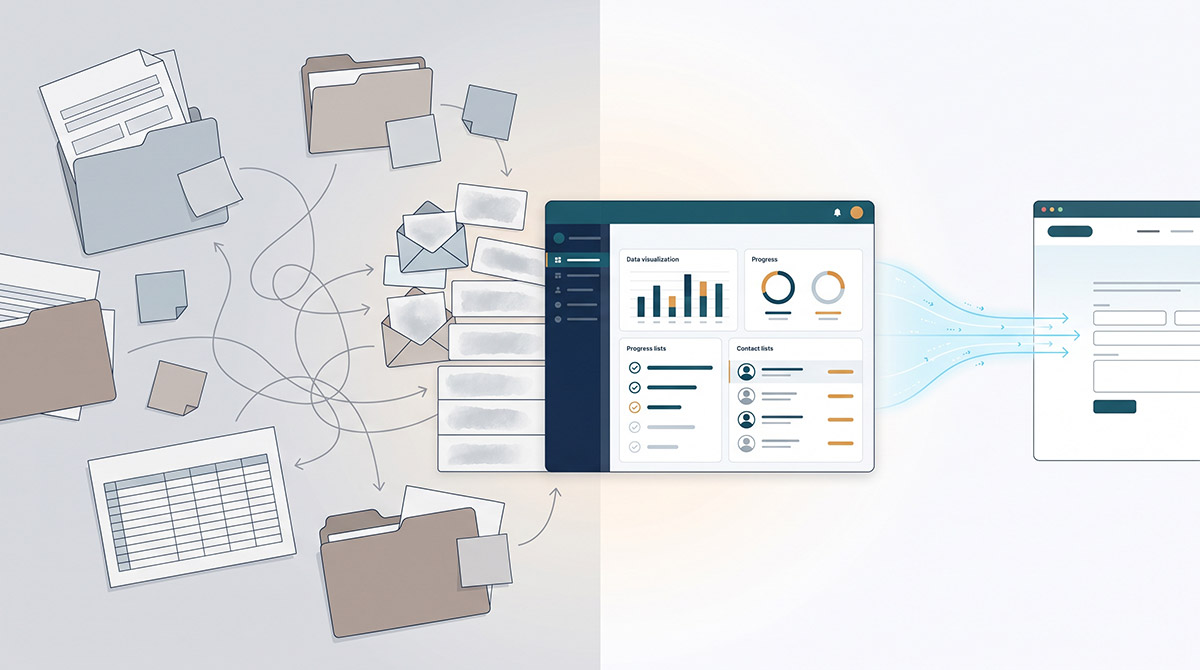


A template website can be live in weeks. A poor-fit website can slow a business down for years. That is the real issue in the custom website vs template decision. It is not just about design preference or upfront budget. It is about whether your website can support the way your organisation operates, integrates and grows.
For smaller, low-complexity sites, a template can be a sensible choice. For organisations managing multiple stakeholders, platforms, approvals, integrations and performance targets, the decision needs more rigour. The website is rarely a standalone asset. It sits inside a wider digital ecosystem, and that changes the economics quickly.
Custom website vs template: the real difference
A template website starts with a pre-built structure. Layouts, components and content patterns are largely defined in advance. You can adapt colours, typography, imagery and some page structures, but the underlying logic is already there. That makes it faster and usually cheaper to launch.
A custom website is designed and developed around your business requirements. That includes user journeys, content models, integrations, governance needs, accessibility standards, security expectations and future growth plans. Rather than fitting your organisation into an existing framework, the framework is built to fit the organisation.
The practical difference is control. Templates offer convenience within limits. Custom builds offer flexibility with more planning, more investment and greater responsibility.
When a template makes commercial sense
Templates are not inherently inferior. In the right context, they are efficient. If your website is primarily informational, has straightforward content, limited integration requirements and a modest traffic profile, a well-chosen template can be a rational option.
This is often true for campaign microsites, early-stage businesses testing a market, or organisations replacing an outdated brochure-style site without changing core systems. If speed matters more than deep functionality, a template may get you to market faster with acceptable trade-offs.
The key phrase is acceptable trade-offs. Template sites tend to work best when your requirements are stable. If your content structure is simple, your teams are comfortable working within predefined constraints, and your reporting or automation needs are light, there may be little value in commissioning a fully custom platform.
That said, many businesses underestimate future complexity. What begins as a simple website often becomes a publishing platform, lead generation engine, service hub, ecommerce channel or integration point for CRM, marketing automation and internal workflows. A template chosen for short-term speed can become expensive once those demands arrive.
Where template websites start to break down
Template websites usually become problematic when business logic and platform logic stop aligning. The more exceptions you need, the more friction appears.
You might need custom user permissions, region-specific content, integration with legacy systems, tailored search behaviour, complex forms, gated resources, CRM field mapping, or nuanced approval workflows. On paper, many template-based platforms say these things are possible. In practice, they often rely on plugins, workarounds and layered customisations that increase technical debt.
That debt shows up in several ways. Performance can suffer as extra code, scripts and plugins accumulate. Governance becomes harder because updates may affect customised components unexpectedly. Security risk can rise if third-party extensions are poorly maintained. Content teams can end up constrained by rigid modules that make everyday publishing slower than it should be.
Most importantly, operational inefficiency creeps in. If staff need manual fixes, duplicate data entry or external tools to complete routine tasks, the website is no longer saving time. It is creating overhead.
Why custom websites cost more and why that can be justified
The upfront cost difference in the custom website vs template comparison is usually obvious. Custom costs more because it includes discovery, solution architecture, UX planning, design systems, tailored development, testing and often more structured deployment governance.
What matters is whether that investment removes larger costs elsewhere.
A custom website can reduce reliance on manual processes, simplify content management, improve lead handling, support cleaner integrations and avoid repeated redesigns driven by platform constraints. It can also provide stronger control over accessibility, compliance, security and user experience, all of which matter more in government, enterprise and regulated sectors.
There is also a strategic benefit. Custom platforms make it easier to align the website with business objectives instead of forcing business objectives through the limitations of a purchased theme. If conversion, service delivery, stakeholder access and data quality matter, that alignment has real commercial value.
The wrong way to assess cost is to compare only the build price. The better question is total cost over three to five years, including maintenance, patchwork development, lost efficiency and missed performance gains.
Performance, SEO and scalability
A template website can perform well if it is well built, carefully configured and lightly customised. Not every template site is slow or poorly optimised. But templates often carry code and design decisions intended to serve many use cases, not your specific one. That can introduce unnecessary weight and compromise front-end performance.
Custom websites allow performance to be designed intentionally. Content structures, page templates, technical SEO, schema, internal search, page speed and conversion paths can all be shaped around real audience behaviour and business priorities. That is particularly relevant when the site is a significant acquisition or service channel.
Scalability is where custom platforms usually pull ahead. A site that needs to support multilingual content, multiple business units, complex product or service data, role-based experiences or future platform integrations will usually benefit from a more deliberate architecture. Retrofitting scale into a rigid template is possible, but rarely efficient.
This is also where strategic planning matters more than design alone. Many website rebuilds fail not because the visuals are weak, but because the platform foundation was not built for what the business needed six months later.
Governance and internal control matter more than many teams expect
For organisations with multiple stakeholders, governance is not a side issue. It affects speed, compliance and risk.
Template sites often look simple from the outside, but simplicity for end users does not always mean control for internal teams. Once plugins, custom snippets and third-party tools are layered in, ownership can become blurred. Who maintains updates? What breaks when a plugin changes? Which content types can different teams edit safely? How are approvals managed? What is the rollback plan?
A custom website gives you more scope to define these controls properly. Editorial workflows, permission models, component libraries and integration rules can be set up to match how your organisation actually works. That does not just reduce risk. It makes digital operations more efficient.
This is one reason larger organisations often move away from template-first builds over time. They need a platform that supports governance as much as publishing.
How to decide between a custom website and a template
The best choice depends on complexity, not ego. A custom build is not automatically the smarter option. It is the smarter option when the cost of constraints is higher than the cost of customisation.
If your organisation needs a clean, simple site with a short timeline and limited integration, a template may be entirely appropriate. If your website needs to connect with CRM, ecommerce, internal platforms, automation tools or service systems, the decision shifts. The website is no longer just a front-end asset. It is part of operational infrastructure.
A useful test is to look beyond launch. Ask what the website must support in two years, who will manage it internally, what systems it must connect to, and what business process failures would be costly. If the answers involve complexity, scale or governance, a custom solution is usually the safer long-term choice.
At ID Digital Agency, this is often where the conversation becomes clearer. Once a website is treated as part of a connected digital ecosystem rather than an isolated project, the trade-offs are easier to evaluate.
A practical way to frame the investment
Think of templates as a fast way to establish presence. Think of custom websites as a way to build capability.
Presence matters, especially when speed and budget are tight. But capability matters more when your digital channels need to generate demand, support operations, integrate data and adapt over time. That is where the custom website vs template question stops being a design discussion and becomes a business decision.
The right answer is not the more expensive option or the faster option. It is the option that gives your organisation the level of control, performance and scalability it actually needs, without paying for complexity that will never be used.
If you are weighing both paths, start with the operating model behind the website, not the homepage design. That usually tells you what will hold up under growth and what will need replacing sooner than expected.