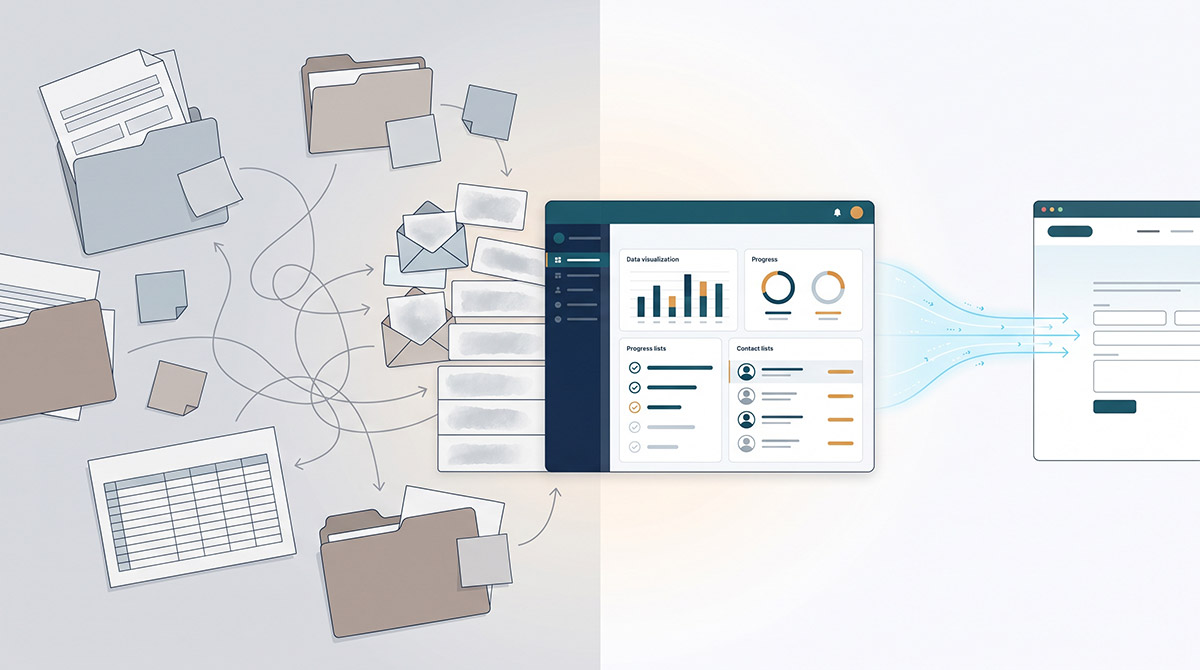


A website that looks polished but sits outside your core systems is rarely an asset for long. For organisations managing multiple platforms, stakeholders and performance targets, website design and development services need to do more than produce a new front end. They need to support operations, connect data, reduce friction and create a stronger foundation for growth.
That is where many projects fall short. The design is approved, the build goes live and the business is left with the same underlying problems: duplicate data, disconnected tools, manual workarounds and limited visibility over what the website is actually contributing. A better website does matter, but a better digital system matters more.
What website design and development services should actually deliver
At a basic level, these services cover strategy, user experience, interface design, content structure, technical development and launch. In practice, that definition is too narrow for organisations with any real operational complexity.
A modern website often sits at the centre of lead generation, customer service, ecommerce, internal workflows, reporting and platform integrations. It may need to connect with a CRM, marketing automation platform, ERP, booking engine, payment gateway, member portal or mobile application. If those requirements are treated as secondary, the website can become another isolated tool instead of a useful business asset.
Strong website design and development services should therefore solve for three things at once. They should improve the user experience, support internal efficiency and create clearer control over performance. If one of those is missing, the result is usually compromised.
For example, a beautifully designed site that is hard to maintain creates governance issues. A technically sound platform with poor information architecture suppresses conversions. A fast launch that ignores integration requirements often introduces more manual handling after go-live. Good delivery is not about a single discipline doing its job well. It is about aligning strategy, design, technology and operations from the start.
Why disconnected delivery creates long-term problems
Many businesses have experienced the pattern. Strategy is handled by one partner, design by another, development by a third and performance by an internal team that inherits decisions it did not shape. On paper, the scope looks covered. In reality, accountability becomes diffuse.
This model tends to create patchwork outcomes. The brand team gets visual consistency, the development team gets a working build and marketing gets a launch date. What nobody gets is a joined-up digital ecosystem.
The cost of that disconnect shows up quickly. Content updates become slow because the CMS was not structured around actual governance needs. Leads enter the website but are not routed cleanly into the CRM. Reporting remains partial because events, form handling and attribution were added late. Teams start compensating with spreadsheets, manual exports and duplicated admin.
That is why the most valuable website projects are not driven by surface-level outputs. They are shaped by the operating model behind the site. Who owns content? Which systems need to exchange data? What approvals are required? How will SEO, CRO and platform updates be managed after launch? These are not technical side notes. They directly affect cost, risk and long-term performance.
The strategic layers behind effective website design and development services
A sound project starts before visual design. It begins with business requirements, user needs and a realistic view of the digital environment the website has to support.
Strategy and platform planning
This stage defines what the website is there to achieve and what it must connect with. For some organisations, that means lead generation and marketing automation. For others, it means ecommerce, customer self-service, stakeholder communications or complex content publishing. The right solution depends on the business model, not on what is fashionable.
Platform selection matters here. A CMS should be chosen for governance, scalability and integration fit, not just editor preference. The same applies to hosting, security, analytics and third-party tools. Short-term convenience can create expensive constraints later.
User experience and content architecture
User experience is often reduced to wireframes and page layouts. In reality, it is also about structure, pathways and decision-making. Can users find what they need quickly? Does the navigation reflect how your audience thinks, not how the business is internally organised? Are forms, service pages and conversion points designed around real behaviour?
Content architecture plays a major role in this. Organisations with broad service offerings, multiple audience groups or decentralised teams need a content model that supports clarity at scale. If the structure is weak, even strong visual design will struggle to perform.
Technical delivery and integration
Development quality becomes visible in performance, flexibility and maintainability. A site that launches on time but is fragile under change is not a strong build. Neither is a site that cannot integrate cleanly with the systems your teams rely on.
This is where senior technical planning matters. APIs, data flows, permissions, search functionality, form logic, ecommerce rules and system dependencies all need to be considered early. Leaving integration until late in the process usually means compromise. It can also expose governance and security issues that are harder to fix under deadline pressure.
How to assess whether a provider is solving the right problem
Not every organisation needs the same depth of delivery. A simple marketing site for a small business has different requirements to a platform used across multiple departments, regions or service lines. The key question is whether the provider understands the level of complexity involved.
A useful test is to look at how they frame the work. If the conversation centres on pages, design styles and launch timing, the scope may be too narrow. If it includes integration, governance, measurement, performance and operational workflows, the project is more likely to create lasting value.
You should also assess how they handle trade-offs. There is rarely a perfect solution across budget, timeline, flexibility and technical ambition. An experienced partner will be direct about what is feasible, what needs staging and where shortcuts create future risk. That level of honesty is worth more than broad promises.
Another signal is how they think about post-launch responsibility. Websites are not static assets. They require optimisation, maintenance, content governance, security oversight and continuous performance improvement. If delivery ends at launch, internal teams often inherit a platform that is harder to manage than expected.
Website design and development services as part of a wider digital system
For many Australian organisations, the website is no longer the whole digital strategy. It is one operating layer within a broader ecosystem that includes paid media, search visibility, CRM, automation, ecommerce, apps, service platforms and reporting.
That wider context changes what good looks like. A website should not simply attract visitors. It should help move data, support decisions and reduce friction across the customer and internal journey. In some cases, that means tighter integration with sales and service systems. In others, it means better governance for large content estates or clearer measurement tied to commercial outcomes.
This is where a more integrated delivery model has practical value. When strategy, UX, development and performance thinking are connected, fewer decisions are made in isolation. The result is usually better control, less rework and a platform that can evolve without constant patching.
For organisations with meaningful digital complexity, that is the difference between replacing a website and improving digital capability. ID Digital Agency works in this space because the real issue is rarely the website alone. It is the disconnected environment around it.
What better outcomes usually look like
The strongest projects tend to produce a similar pattern of benefits. Teams gain clearer governance over content and platform changes. Users get faster, more intuitive experiences. Data moves more reliably between systems. Reporting becomes more useful because tracking is planned properly. And the website becomes easier to improve over time, rather than harder.
That does not mean every project should aim for maximum complexity. Sometimes the right decision is to simplify the stack, reduce custom development or stage integrations over time. Commercial discipline matters. The goal is not to add more technology. It is to create a digital foundation that is fit for purpose and sustainable to manage.
That is the standard website design and development services should be held to. Not whether a site launches with a fresh look, but whether it improves how the organisation operates, performs and grows. If your next website cannot do that, it is probably not solving the right problem.
The most useful starting point is often a hard question: what needs to work better across the business once the new site is live? Answer that honestly, and the project becomes far more valuable.