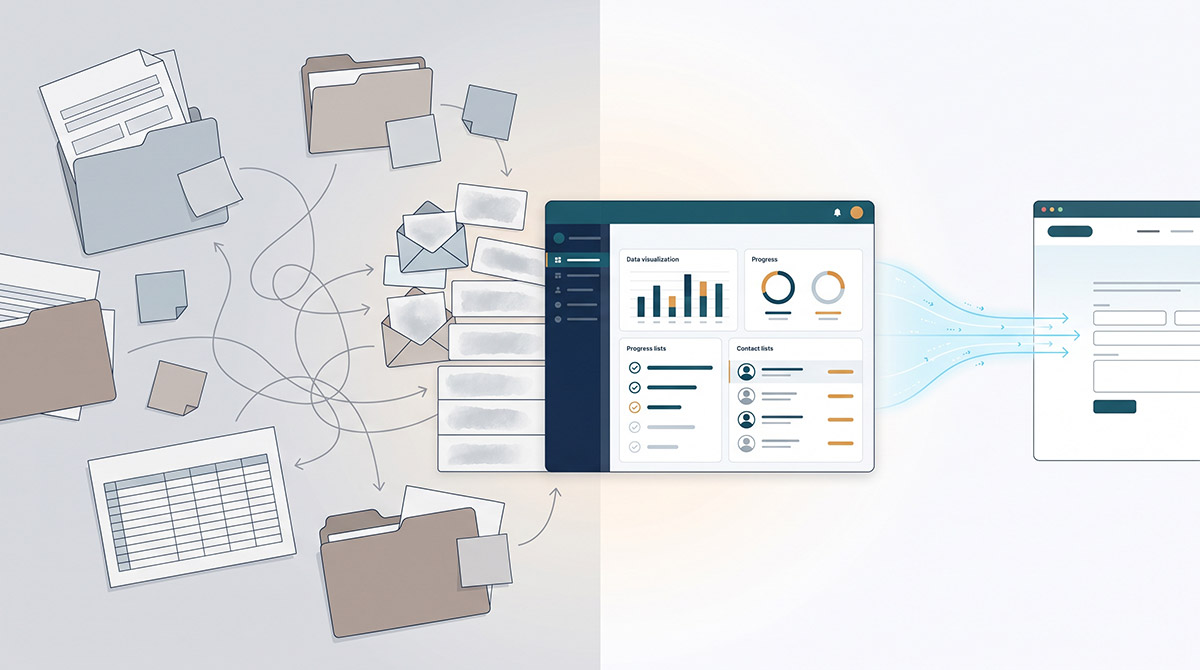


When a lead submits a form, downloads a resource, speaks to sales and later becomes a customer, that journey should not be split across four systems and three spreadsheets. CRM and marketing automation integration fixes that gap. It gives your business one connected view of demand, pipeline and customer activity, so teams can act on the same information instead of interpreting conflicting versions of it.
For organisations with multiple channels, longer sales cycles or layered stakeholder groups, this is not a nice-to-have. It is a control issue. If marketing cannot see what becomes qualified pipeline, sales cannot trust lead history, and operations cannot rely on customer data, performance suffers in quiet, expensive ways. Budget goes to the wrong campaigns, follow-up slows down, reporting becomes subjective and manual work grows around the cracks.
What CRM and marketing automation integration actually does
At a practical level, CRM and marketing automation integration connects contact, company and activity data between your marketing platform and your CRM. That includes form submissions, email engagement, lead source data, lifecycle stages, sales notes, opportunity status and customer records. Instead of each platform holding a partial truth, the integration keeps critical fields aligned and updates them according to agreed rules.
That sounds straightforward, but the value is not in the connection alone. The value comes from how the connection is designed. If the field mapping is poor, if duplicate handling is weak, or if ownership rules are unclear, the integration will only move bad data faster. A connected system still needs governance.
Done properly, the result is better timing and better decisions. Marketing can tailor nurture activity based on actual sales progression. Sales can prioritise outreach using behavioural signals that matter. Leadership can assess performance across the full funnel rather than reading disconnected platform reports.
Why disconnected systems create hidden cost
Many businesses tolerate fragmented platforms because each piece works well enough on its own. The website captures leads. The CRM stores contacts. The email platform sends campaigns. The problem appears when you need the whole system to answer a basic commercial question such as which channels are producing qualified revenue, or how long it takes a marketing lead to become a customer.
Without integration, teams create workarounds. They export lists, clean CSV files, re-enter notes, chase attribution through UTM parameters and rely on individuals to keep records up to date. None of that scales well. More importantly, it introduces delay and inconsistency at the exact point where speed and accuracy matter.
This is why integration tends to become urgent once an organisation reaches a certain level of complexity. More channels, more stakeholders and more customer touchpoints increase the cost of disconnected data. The issue is rarely one dramatic failure. It is the slow erosion of efficiency, confidence and visibility.
The business case for CRM and marketing automation integration
The strongest case for integration is usually operational before it is technical. Businesses do not invest in it because syncing records is interesting. They invest because fragmented systems weaken growth.
A connected setup improves lead management first. Enquiries can be scored, routed and assigned with clearer logic, reducing lag between interest and follow-up. It also improves campaign relevance. If your automation platform knows whether a prospect is already in a live opportunity, recently closed or currently a customer, messaging can reflect reality rather than blanket assumptions.
Reporting becomes more credible as well. Marketing can be assessed against qualified pipeline and revenue contribution, not just opens, clicks or raw lead volume. Sales can see the engagement history behind each contact. Executives get a clearer view of where performance is improving, where it is stalling and which parts of the funnel need attention.
There is also a governance benefit. When customer and prospect data move through a controlled process rather than ad hoc handling, your business reduces duplicate records, inconsistent field use and compliance risk. That matters for enterprise organisations, government bodies and any business expected to maintain stronger oversight of data quality and process integrity.
Where integrations usually go wrong
The common failure is assuming the software connection is the strategy. It is not. Plugging one platform into another without defining lifecycle stages, lead ownership, field priorities and reporting requirements usually creates confusion faster than it solves it.
One example is lead status. Marketing may define a marketing qualified lead one way, while sales uses a different threshold entirely. If those definitions are not aligned before integration, your workflows will automate disagreement. Another common issue is duplicate logic. If the website creates new contacts too freely, or if data sources do not match records reliably, both systems become cluttered and trust drops quickly.
There is also the temptation to sync everything. That is rarely wise. Not every field needs to move both ways, and not every event should trigger automation. Over-syncing creates noise, makes troubleshooting harder and can affect system performance. Better integrations are selective. They move the data that supports decisions, action and reporting.
How to approach integration properly
A stronger approach starts with commercial intent. What should the integrated system help your business do better? Shorten response times, improve pipeline attribution, reduce manual handling, support account-based marketing, strengthen customer retention, or all of the above? The answer shapes the design.
From there, define the operating model before the build. That means agreeing on lifecycle stages, lead qualification rules, ownership transitions, field definitions and exception handling. It also means deciding which platform is the source of truth for each data set. In most cases, your CRM should hold the authoritative sales and account record, while the marketing platform manages campaign engagement and automation logic. There are exceptions, but they should be deliberate.
Then comes the technical layer. Form architecture, API capability, middleware requirements, custom objects, consent management and reporting structures all need review. If your website, CRM and automation platform were implemented by different vendors at different times, there may already be conflicting assumptions built into the system. Good integration work identifies those early rather than patching over them.
Testing matters more than most teams expect. You need to test not only whether records sync, but whether workflows behave correctly under real conditions. What happens when a prospect changes company? When a customer submits a new enquiry? When a salesperson updates opportunity stage after an automation trigger has already fired? Those edge cases are where weak integrations break.
CRM and marketing automation integration is not one-size-fits-all
A mid-market business with a short sales cycle may need a relatively lean integration focused on lead capture, scoring and handover. An enterprise organisation may need more complex logic around business units, territories, service lines, procurement stages and customer hierarchies. Government and regulated sectors may place heavier emphasis on permissions, auditability and data handling rules.
The right model depends on your sales process, channel mix and internal structure. Some businesses need near real-time sync because fast response drives conversion. Others care more about clean weekly reporting and dependable segmentation. Some need sophisticated nurture paths. Others need simpler automation but stronger account visibility in the CRM.
This is where senior planning matters. The objective is not to copy a standard integration pattern. It is to design a connected operating environment that reflects how your organisation actually acquires, manages and grows customer relationships.
What good looks like after implementation
You can usually tell when the integration is working because teams stop talking about the systems and start talking about outcomes. Marketing knows which campaigns are producing qualified demand. Sales trusts the contact history enough to use it. Operations sees less manual correction. Leadership gets reporting that holds up under scrutiny.
There are more tangible indicators too. Duplicate records decline. Lead response times improve. Nurture programs become more relevant. Attribution is less disputed. Pipeline reporting is cleaner. Website forms, CRM workflows and campaign automation start behaving as part of one ecosystem rather than separate tools with occasional overlap.
That is the broader point. Integration is not about making software talk for the sake of it. It is about building a digital environment with less friction, more accountability and clearer performance signals. For organisations managing complexity, that shift changes how confidently they can invest, scale and optimise.
ID Digital Agency works with organisations facing exactly this problem: good platforms, inconsistent connections and too much manual effort holding the system together. The real opportunity is not another patch. It is a better foundation. When your CRM, marketing automation and digital platforms operate as one connected system, growth becomes easier to measure and much easier to manage.
If your team is still spending more time reconciling data than acting on it, the integration question has already become a performance question.